

-
call us
0086 13559245184 -
email us
sales@fortunepart.com
call us
0086 13559245184email us
sales@fortunepart.com
Oct, 2026
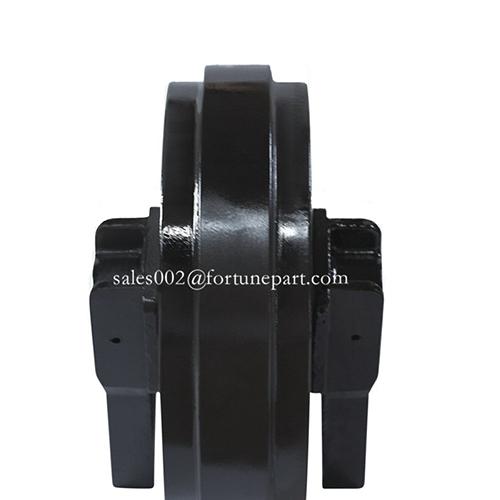
When an undercarriage starts making noise, running rough, or wearing unevenly, the first question is usually which component is responsible. On most crawler machines there are two different roller families working in the same system: bottom rollers that carry the machine weight, and top rollers that support the return side of the chain. Their symptoms overlap enough that owners often replace the wrong part, then find the problem is still there. This guide compares the two, shows how the symptoms differ, and walks through a simple diagnosis sequence. If you are already sourcing parts, it also helps to understand how Track Rollers For Excavators And Bulldozers are grouped by machine and position, because the position on the undercarriage is part of what identifies the correct part.
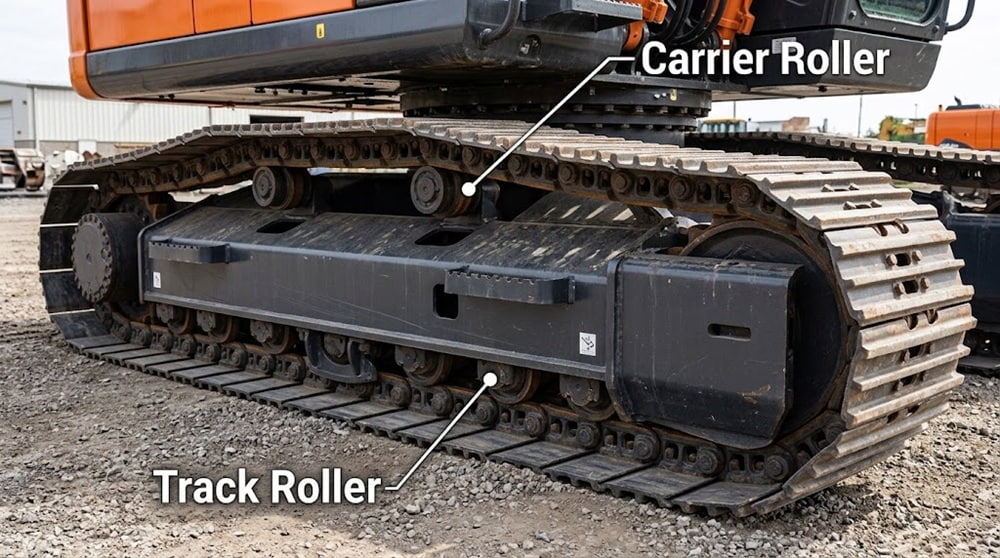
The confusion starts with the names. In everyday conversation, people say "roller" for both parts, but they do different jobs in different places.
Because one works under the machine and the other works above it, they experience different loads. Bottom rollers take direct ground impact, abrasion, and the full machine weight. Top rollers take chain weight and less impact, but they still fail from seal damage, lack of rotation, and contamination.
| Feature | Track Roller (Bottom) | Carrier Roller (Top) |
|---|---|---|
| Position | Along the bottom of the track frame | On top of the track frame |
| Main job | Carries machine weight and guides the chain on the ground | Supports the return side of the chain |
| Typical load | High weight plus ground impact and abrasion | Chain weight with less direct impact |
| Number per side | Several, depending on the machine | Usually fewer than the bottom rollers |
| Common failures | Flange wear, diameter wear, seal leaks, flat spots | Seized bearing, worn flange, seal leak, chain cutting into the roller |
The fastest way to separate the two is to look at where the problem appears. Ground-level problems usually point to bottom rollers, while problems visible above the track frame point to top rollers.
| Symptom | More Likely Source | What to Check |
|---|---|---|
| Chain climbing or derailing at the bottom | Track roller | Flange wear, roller alignment, track tension |
| Machine pulls to one side while tracking straight | Track roller | Seized or heavily worn rollers on one side |
| Grinding noise near the ground | Track roller | Seized bearing, flat spots, dry seal |
| Chain sagging onto the top of the track frame | Carrier roller | Seized top roller, worn roller diameter, loose mounting |
| Noise from the upper part of the undercarriage | Carrier roller | Roller not rotating, damaged bearing, chain contact marks |
| Uneven wear on the top of the chain links | Carrier roller | Worn or seized top roller surface |
One warning is worth repeating: a problem that looks like a roller fault can come from track tension. A chain that is too loose can create symptoms on both top and bottom rollers, so tension should always be checked before parts are ordered.
Work through the following steps in order. The sequence takes only a short time and prevents most wrong-part orders.
If the machine is difficult to lift or the rollers cannot be reached safely, ask a workshop to perform the check. Diagnosis on a raised machine is quicker and safer than guessing from noise alone.
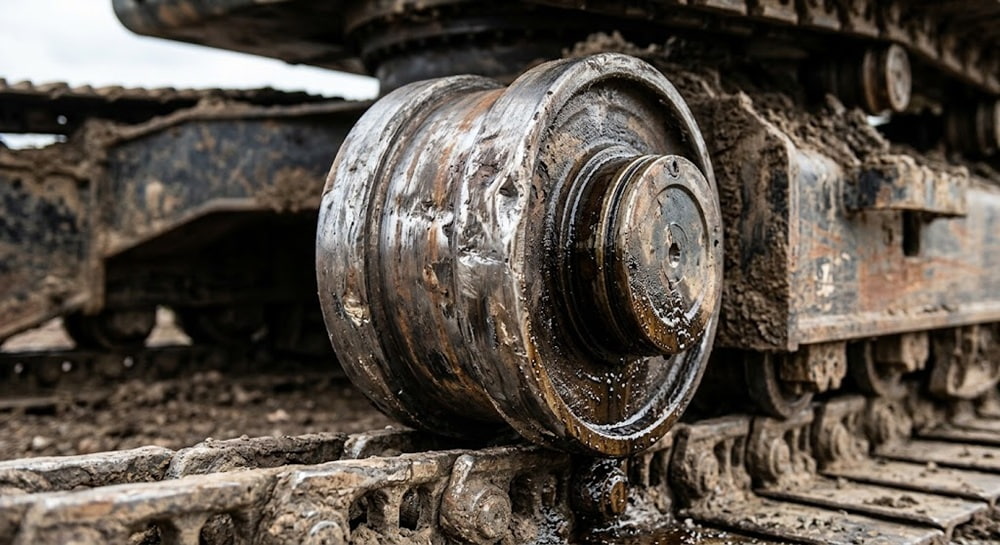
Bottom rollers usually wear out gradually through abrasion. Top rollers often fail in a different way, because they are more likely to stop rotating. When a top roller seizes, the chain slides over it instead of rolling, which wears a flat area into the roller surface and can cut into the chain bushings over time.
The reason is partly design and partly environment. Top rollers carry a lighter load, so a failing bearing does not always announce itself with heavy noise. They also sit in a position where mud and debris can collect, and where lubrication is sometimes forgotten during service. Operators comparing replacement options usually look for rollers with reliable sealing and a design that tolerates long periods of rotation, which is why the range of Excavator Carrier Rollers is organized by machine model and mounting style so the correct unit can be matched to the track frame.
Replacing the wrong roller does not only waste money. It also delays the real repair and can increase damage in the meantime:
A complete undercarriage check, rather than a single-part replacement, is the cheaper route in most cases.
Roller wear on a machine is never perfectly even. When several rollers in the same position show similar wear, replacing them as a set keeps the load balanced and the chain running straight. Mixing a new roller with badly worn neighbors simply moves the wear to the new part.
Some machines also use a design where the top roller can be replaced without removing the entire assembly. On these machines, the roller body is renewed while the mounting bracket stays in place, which reduces labor time and keeps the machine closer to production. This is worth confirming when comparing replacement options, since the cost difference between a full assembly and a replaceable roller is significant. Maintenance teams that plan undercarriage work around this feature often check the Replaceable Top Roller For Crawler Excavators as a reference for how the replaceable design is specified, including the roller dimensions and the mounting details needed for a correct match.
Most roller failures come from a small number of avoidable causes. The following habits protect both top and bottom rollers:
None of these tasks takes long, and together they prevent most of the roller replacements that become urgent during a busy period.
Locate the noise by position. Noise from near the ground points to bottom rollers, while noise from above the track frame points to top rollers.
A seized or badly worn carrier roller mainly affects the return side of the chain. Derailing at the ground contact line is more often linked to bottom rollers, tension, or alignment.
No. Bottom rollers carry much more load and usually wear faster, while top rollers are more likely to fail from seizing or seal damage.
Yes, when several rollers show similar wear. Replacing a full set keeps the load balanced and protects the chain from uneven wear.
The machine model and serial number, the roller position, the original part number if available, and key dimensions such as roller diameter, shaft diameter, and flange type.
Track rollers and carrier rollers look similar in a parts list but work in different positions and fail in different ways. Check the location of the symptom first, confirm track tension, then inspect the rollers that match that position. Bottom rollers usually show flange wear, diameter wear, and leaks under the machine, while top rollers usually seize, wear flat, or stop rotating above the track frame. Diagnose before ordering, replace worn rollers as a set where possible, and keep tension and lubrication under control. Done this way, the undercarriage stays dependable and the machine stays on the job.
Contact fortunepart.com with your machine model, serial number, and roller position, and we will help you confirm whether a track roller, a carrier roller, or another undercarriage part is the right replacement.
categories
recent posts
tags
Xiamen Fortune Industrial Co., Ltd.
Room 402,No.7,Kangleli,Huli District, Xiamen, Fujian, China
Tel : 0086 13559245184
Fax : 0086-592-7072790
Whatsapp/Wechat : +8613559245184
Contact Person: James Xie
E-mail: sales@fortunepart.com
Microsoft Teams: part-sales
scan to wechat: